

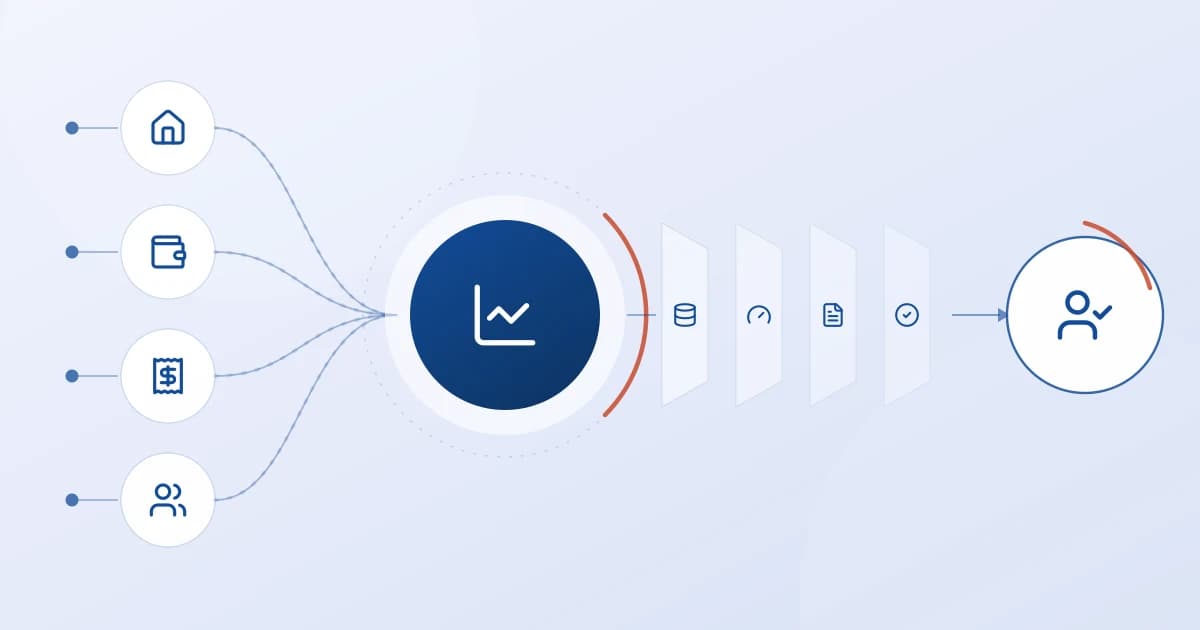
Alternative credit data is financial information outside traditional bureau files — bank-account cash flow, income and employment verification, and utility or rent payment history. For the roughly 45 million Americans who are credit-invisible or thin-file, it reveals creditworthiness that FICO and bureau models miss, letting lenders assess and approve borrowers competitors cannot reach.
The Credit Invisible Population
Approximately 45 million Americans have limited or no traditional credit history — a population that credit scoring models built on bureau data cannot adequately assess, not because these individuals are poor credit risks, but because the data used to evaluate creditworthiness does not include their financial behavior.
This is not primarily a social equity problem — though it is that too. It is a market opportunity that lenders with the right data infrastructure can address. The 45 million Americans underserved by traditional credit scoring represent potential borrowers who pay rent, maintain bank accounts, earn regular income, and manage their finances in ways that are visible through alternative data sources but invisible to conventional credit bureau models.
Alternative credit data — bank account cash flow, income verification, utility and rent payment history, and employment data — provides the signals that traditional bureau data misses. For lenders, accessing this data compliantly and feeding it into cash-flow underwriting software is the path to serving borrowers that competitors with bureau-only infrastructure cannot reach.
LASER integrates Plaid's data aggregation directly into the Salesforce lending workflow — bringing bank statement data, income verification, and cash flow analysis alongside bureau credit reports in a single decisioning environment. Schedule a Discovery Call to see how alternative data integration works in practice.
What Alternative Data Reveals That Bureau Files Cannot
Traditional FICO scores and bureau-based models analyze a consumer's history with formal credit products. This works well for consumers who have established credit histories through loans, revolving accounts like credit cards, and reported accounts. For the 45 million thin-file or credit-invisible consumers, it produces a fundamental assessment gap:
| What Bureau Data Shows | What Alternative Data Shows |
| Payment history on formal credit | Bank account cash flow patterns |
| Credit utilization ratios | Income stability and regularity |
| Length of credit history | Expense management behavior |
| Mix of credit products | Utility and rent payment history |
| Inquiries | Employment verification |
Harvard Business School research found that alternative data in lending models reduced rejection by 70% for borrowers typically excluded by traditional scoring — borrowers who, when approved, demonstrated performance comparable to or better than borrowers approved through conventional scoring alone. That same dynamic is now reaching the mortgage market: the FHA's new credit scoring rules for mortgage lenders approve VantageScore 4.0 and FICO 10T — models that incorporate alternative and trended data — for federally backed home loans, extending thin-file scoring capability to mortgage applicants.
The cash flow signal is particularly powerful. Cash-flow-based underwriting — analyzing income deposits, expense patterns, and the ability to meet recurring obligations like rent, utilities, and subscriptions — reflects real financial behavior that the credit bureau data model was never designed to capture.
The Regulatory Framework for Alternative Data Use
Using alternative data in credit decisions requires careful compliance navigation. The regulatory framework depends on how the data is obtained and how it is used:
Bank statement and cash flow data obtained through permissioned aggregation — such as data accessed through Plaid with consumer authorization under the CFPB's Section 1033 framework — operates under a consumer-permissioned data sharing model. The FCRA applicability of this data depends on whether it is obtained from a consumer reporting agency and whether it constitutes a "consumer report."
Income verification services that access employment and payroll data to verify income claims are typically consumer reports under FCRA when used in credit decisions, triggering permissible purpose, accuracy, and adverse action obligations.
Utility and rent payment history reported to credit bureaus by data furnishers is a consumer report under FCRA. This data is increasingly incorporated into VantageScore 4.0 and other alternative scoring models.
For every alternative data source, lenders must verify: Does this constitute a consumer report under FCRA? If yes, full FCRA compliance obligations apply. If no, what consumer consent and data protection obligations apply under GLBA and applicable state privacy laws?
The CFPB's Section 1033 open banking rule — which supports consumer-permissioned data sharing — is creating clearer regulatory pathways for compliant alternative data use. Lenders who build their alternative data infrastructure against this regulatory framework are positioned for sustainable compliance rather than case-by-case uncertainty.
FICO and VantageScore: Incorporating More Data Signals
The scoring model changes discussed in our FICO direct licensing analysis are partly a response to the same market dynamic: the recognition that traditional bureau-only models leave significant creditworthy population unserved.
VantageScore 4.0 — which the FHFA now allows for GSE-backed mortgage underwriting — incorporates trended data, rental history where available, and a broader set of financial signals than Classic FICO. The FHFA's allowance of VantageScore 4.0 as an alternative scoring model is an implicit regulatory signal that expanded data use in credit decisions is supported.
For lenders using LASER's ACCESS pillar, this scoring model evolution is compatible with existing bureau integration infrastructure — adding VantageScore 4.0 alongside Classic FICO does not require separate integration work.
Building Alternative Data Capability That Complies at Scale
The operational challenge of alternative data use is not data access — it is compliance at scale. Individually reviewing bank statements or income data is feasible at low origination volume. At scale, it requires automated workflows that:
Capture consumer authorization at the point of data access — whether through Section 1033 consumer-permissioned connections or FCRA-compliant consumer report access.
Document permissible purpose for each data access event, with records retained alongside the credit file.
Apply consistent decisioning criteria to alternative data signals — preventing the inconsistency that creates ECOA fair lending risk when alternative data is used informally.
Generate adverse action documentation that accurately reflects the factors — including alternative data signals — that influenced a credit decision.
LASER's integration with Plaid's data aggregation services brings bank statement data, income verification, and cash flow analysis into the same Salesforce workflow as bureau credit reports — ensuring that alternative data use is subject to the same documentation standards and compliance controls as traditional credit data. Alternative data sits beside traditional bureau data in the same workflow — credit bureau integration for Salesforce lenders covers how both feed one decision record.
What This Means for Your Institution
The 45 million Americans underserved by traditional credit scoring are not a fringe market. They are existing and potential borrowers whose creditworthiness the current bureau data model was not designed to assess. Lenders with the infrastructure to access and analyze alternative data compliantly can serve this population in ways that competitors without that infrastructure cannot.
The regulatory pathway is clearer than it has ever been. The technology to access and integrate alternative data is mature. The remaining operational requirement is building compliance workflows that scale — treating alternative data with the same documentation discipline as bureau data, and ensuring that expanded credit access does not create new compliance exposure.
Schedule a Discovery Call to see how LASER's Plaid integration brings bank statement data, income verification, and cash flow analysis into your Salesforce lending workflow alongside bureau credit reports.