
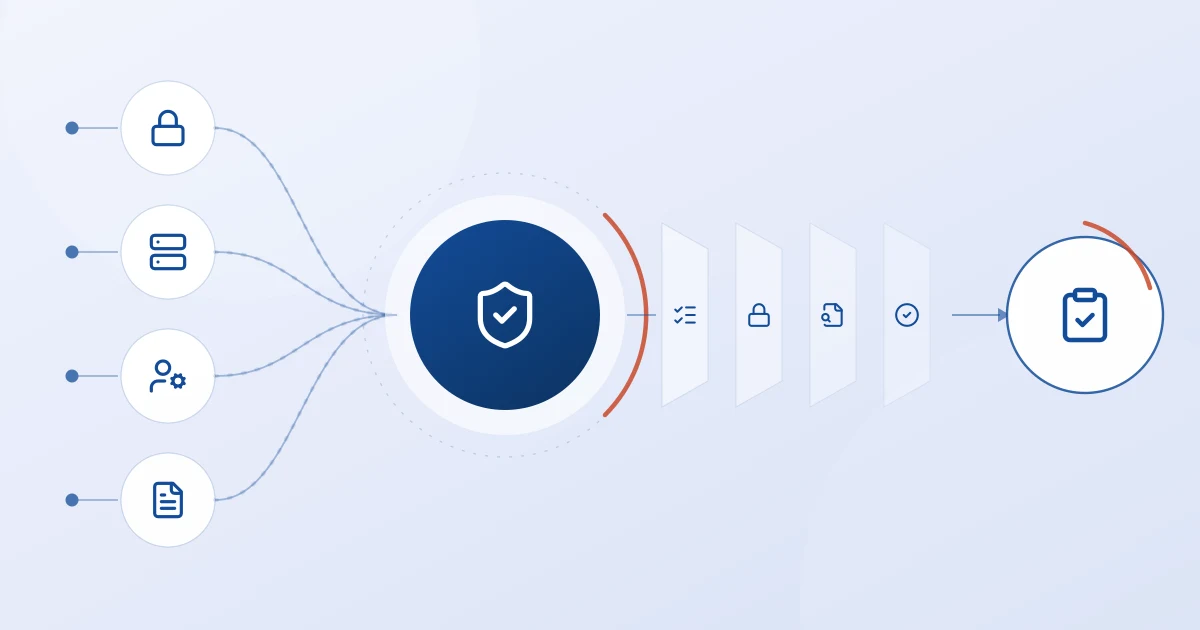
What does the FTC Safeguards Rule require?
The FTC Safeguards Rule (16 CFR Part 314) requires non-bank financial institutions to build and maintain a written information security program that protects customer data. It mandates nine specific elements — including a qualified individual, risk assessments, access controls, encryption, and multi-factor authentication — plus, since May 2024, notifying the FTC of qualifying data breaches.
Why the FTC Safeguards Rule Matters for Lenders
The revised FTC Safeguards Rule represents one of the most significant regulatory shifts for non-bank financial institutions in the past decade. The major provisions carried a compliance deadline of June 9, 2023, and a later amendment — effective May 13, 2024 — added a breach-notification requirement. Together they replaced the previous principles-based approach with a prescriptive standard: every covered financial institution must now maintain a written information security program built around the nine requirements set out in 16 CFR 314.4.
For lenders operating on Salesforce, the practical question is how much of this can be operationalized inside systems your team already uses, rather than managed as a separate, periodic compliance exercise. Several of the Rule's requirements map directly onto capabilities the platform already provides.
The Nine Core Requirements: What 16 CFR 314.4 Demands
The revised Safeguards Rule is organized into nine lettered requirements, §314.4(a) through (i). Understanding each — and how it maps to your operational reality — is the first step toward a compliant information security program.
1. Designate a Qualified Individual
Your institution must designate a single qualified individual to oversee and implement the information security program. This person can be an employee, an affiliate, or a service provider — but they must have demonstrable expertise and authority to direct compliance activities. The key requirement is accountability: regulators want a named individual responsible for the program, not a committee or a vague organizational reference.
2. Conduct a Written Risk Assessment
A comprehensive, written risk assessment must identify reasonably foreseeable internal and external risks to the security, confidentiality, and integrity of customer information. This assessment must evaluate the sufficiency of existing safeguards and be documented in a format that examiners can review. Many institutions fail this element by conducting assessments informally or failing to document their methodology and findings.
3. Design and Implement Safeguards — Eight Specific Controls
This is the most extensive requirement. Based on the risk assessment, your institution must design and implement safeguards across eight specific controls:
- Access controls — authenticate users and limit each to only the customer information needed for their duties
- Asset inventory — identify and manage the data, devices, systems, and personnel that handle customer information
- Encryption — protect all customer information both in transit over external networks and at rest (or document Qualified-Individual-approved compensating controls where encryption is infeasible)
- Secure development practices — for in-house applications, plus procedures to evaluate externally developed apps
- Multi-factor authentication — required for anyone accessing any information system, absent written approval of equivalent controls
- Secure disposal — dispose of customer information no later than two years after its last use, with periodic review of retention policies
- Change management — formal procedures governing changes to systems
- Monitoring and logging — log authorized-user activity and detect unauthorized access or tampering
Institutions frequently treat encryption and access controls as "the safeguards" and overlook disposal, change management, and monitoring as named obligations. All eight are required.
4. Regularly Monitor and Test Safeguards
Safeguards must be regularly monitored and tested to ensure they remain effective. The Rule provides two compliance paths: continuous monitoring through system-level controls, or annual penetration testing combined with vulnerability assessments at least every six months. For institutions operating on Salesforce, platform-level security monitoring and automated testing tools can streamline this requirement significantly.
5. Implement Security Awareness Training
All personnel must receive security awareness training, and specialized training must be provided to personnel with hands-on security responsibilities. Training must be updated to reflect risks identified in the most recent risk assessment. This is not a one-time checkbox — it is an ongoing obligation that adapts to your institution's evolving threat landscape.
6. Oversee Service Providers
Your institution must take reasonable steps to select and retain service providers that maintain appropriate safeguards. This includes contractual requirements for service provider security practices and periodic assessment of their compliance. For lenders using third-party credit reporting agencies, data aggregation services, or CRM integrations, this element requires documented vendor risk management procedures.
7. Keep the Information Security Program Current
The information security program must be evaluated and adjusted as circumstances change — including changes in business operations, the results of testing and monitoring, security incidents, and shifts in the threat landscape. Static programs that are written once and shelved fail this requirement by design.
8. Create an Incident Response Plan
A written incident response plan must address how the institution will respond to, and recover from, security events that materially affect the confidentiality, integrity, or availability of customer information. The plan must identify the goals, internal processes, communication protocols, and remediation steps for incident response.
9. Report to the Board
The qualified individual must report in writing, at least annually, to the institution's board of directors (or equivalent governing body) on the overall status of the information security program, including compliance with the Safeguards Rule, risk assessment findings, and security events. This board-level reporting requirement ensures that information security receives executive attention and resource allocation.
The Breach Notification Requirement
Since May 13, 2024, the Rule requires covered institutions to notify the FTC of a security breach affecting 500 or more consumers no later than 30 days after discovery, using the FTC's online form. An event is considered "discovered" the first day it's known to any employee or agent other than the person responsible for the breach. This is the Rule's most recent and most time-sensitive addition — and the one most likely to catch an under-prepared institution off guard, because the clock starts at internal discovery, not at confirmation of harm.
How Salesforce-Native Compliance Streamlines Safeguards Adherence
For institutions already operating on Salesforce, the path to Safeguards compliance is more streamlined than many realize. The platform's native security architecture — role-based access controls, field-level encryption, comprehensive audit trails, and configurable sharing rules — directly addresses several of the Rule's nine elements.
The only Salesforce-native credit access platform with pre-built, pre-configured objects and no additional setup required, LASER Credit Access® embeds compliance safeguards directly into the lending workflow. Rather than bolting compliance checks onto existing processes as an afterthought, institutions can operationalize Safeguards requirements into the daily activities their teams already perform. Our automated lending compliance software page details how role-based access, a zero-intermediary data architecture, and per-pull audit trails map onto the access-control and monitoring elements above.
What This Means for Your Institution
The FTC Safeguards Rule is not optional, and enforcement is accelerating. Institutions that treat compliance as a documentation exercise rather than an operational priority face increasing risk — not only from regulatory action, but from the reputational and financial consequences of security incidents that proper safeguards would have prevented. For lenders mapping Safeguards Rule obligations against the wider 2026 enforcement environment, our analysis of how Safeguards Rule expectations connect to broader 2026 enforcement priorities shows how cybersecurity documentation requirements now sit alongside UDAAP, AI model risk, and state privacy obligations as parallel examination focus areas.
Enforcement of the Safeguards Rule is active and expanding, and the staggered deadlines mean some requirements — particularly breach notification — are still new enough that many institutions haven't fully operationalized them. For lenders already on Salesforce, the most efficient path is to meet as many of the nine requirements as possible through the platform's native security capabilities and purpose-built compliance tooling, rather than maintaining a parallel compliance apparatus.
This article is for informational purposes and does not constitute legal advice. Consult qualified legal counsel for guidance on your institution's specific compliance obligations.