

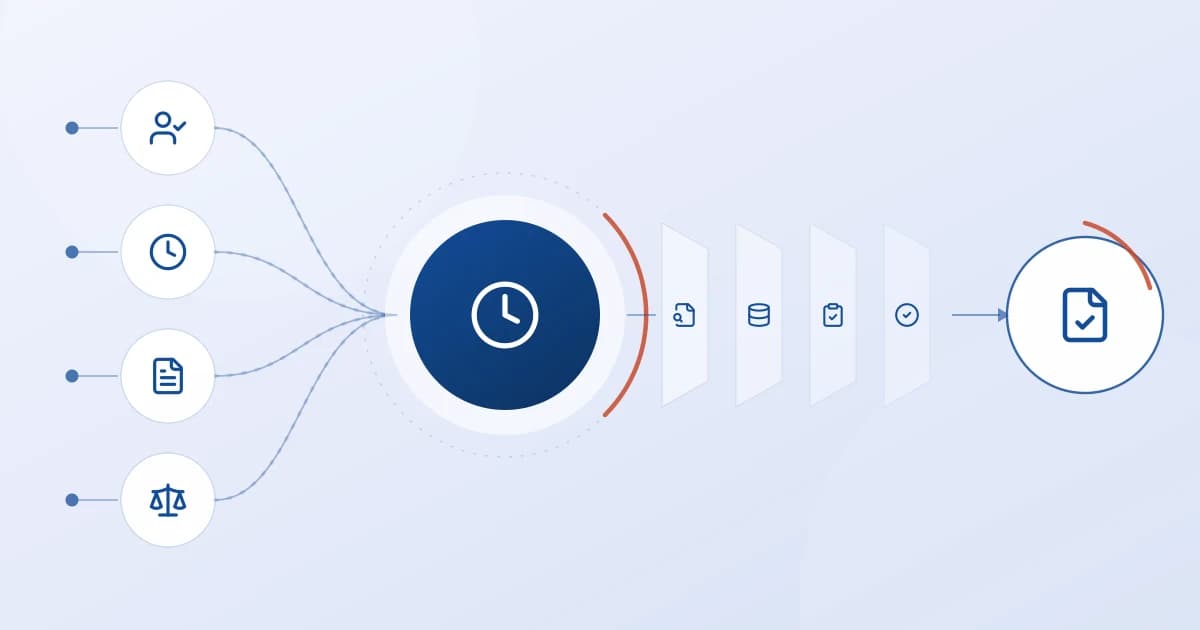
KYC timing is when identity verification happens relative to the credit pull. The safer compliance posture is to complete KYC/CIP identity verification before accessing a credit report — so you don't pull reports on fraudulent or synthetic applicants, and you preserve a clean permissible-purpose and audit trail under the FCRA and the Bank Secrecy Act.
The Compliance Gap Most Lenders Don't See
Financial institutions routinely manage two separate regulatory frameworks — the Fair Credit Reporting Act and the Bank Secrecy Act's Anti-Money Laundering requirements — without fully recognizing how they interact at the moment of credit application. That interaction creates a timing gap that sophisticated fraudsters have learned to exploit.
The question lenders most often ask is whether they must complete Know Your Customer procedures before accessing consumer credit reports. The answer reveals a regulatory nuance that, once understood, becomes a meaningful compliance and fraud prevention advantage. For institutions operating on Salesforce, embedding the answer into the workflow is the difference between a compliance gap and a compliance control.
LASER's COMPLY pillar automates this sequencing — ensuring CIP verification completes before credit report access is enabled, every time. See how it works for your lending program.
What FCRA and BSA/AML Each Require
The FCRA does not explicitly require completion of KYC or Customer Identification Program procedures before obtaining consumer reports. The FCRA focuses on establishing permissible purpose and ensuring the report is obtained for a legally recognized reason — evaluating a credit application, reviewing an existing account, or collecting on a debt.
BSA/AML regulations operate on a different axis. The credit KYC requirements under 31 CFR § 1020.220 mean financial institutions cannot establish new accounts — including credit facilities and extensions of credit — without first verifying customer identity. The sequencing is as important as the verification itself.
| Regulatory Framework | Requirement | Timing |
| FCRA | Permissible purpose to pull consumer report | Before credit pull |
| BSA/AML (CIP) | Identity verification | Before account opening |
| Combined best practice | CIP verification → then credit pull | Sequential |
The gap between these frameworks is real. A lender could technically pull a credit report with permissible purpose before completing CIP verification — but doing so creates both a BSA/AML compliance deficiency and a vulnerability to synthetic identity fraud. And where a pull is run without a valid permissible purpose in the first place — a mis-keyed identifier, or a soft check that executes as a hard one — the obligation shifts to remediation, the discipline of removing an unauthorized hard inquiry.
Why Synthetic Identity Fraud Targets This Gap
Synthetic identity fraud — where criminals combine real and fabricated information to create fictitious identities — is specifically engineered to exploit incomplete identity verification at the point of credit application. These fabricated identities are designed to pass standard document checks and build plausible credit histories before executing a bust-out.
The credit application process is where incomplete identity verification allows fraudulent profiles to gain their first foothold. When lenders pull credit reports before verifying identity, they risk establishing credit files for identities that don't exist — files that become the foundation for increasingly sophisticated fraud schemes.
Completing rigorous CIP verification before pulling credit reports serves as the primary structural defense against this pattern. Cross-referencing identity elements — full legal name, date of birth, address, and identification number — against authoritative data sources before accessing credit data catches identity inconsistencies before a credit relationship begins.
The Strategic Objectives of Proper KYC Sequencing
Establishing identity and collecting CIP information before pulling credit reports addresses multiple compliance and operational objectives simultaneously:
- FCRA accuracy compliance — ensuring the report information pertains to the correct, verified consumer
- BSA/AML CIP compliance — satisfying pre-account verification requirements before credit is extended
- Synthetic identity fraud defense — catching fabricated identities before a credit file is established
- Adverse action documentation — maintaining a clean identity verification record if an adverse action notice is required
- Audit trail integrity — generating regulators' required documentation as a byproduct of the lending workflow
When non-documentary KYC verification involves pulling consumer credit data, FCRA compliance obligations — including permissible purpose documentation, accuracy requirements, and adverse action obligations — apply alongside BSA/AML CIP requirements. GLBA compliance further governs how the personal financial information collected during CIP must be protected throughout the lending relationship.
Turning a Compliance Gap Into a Competitive Advantage
Lenders who treat KYC sequencing as a compliance checkbox miss the broader opportunity. Institutions that enforce proper sequencing systematically — through technology rather than policy alone — operate with measurably different fraud exposure profiles than those relying on manual compliance steps.
The difference is not just regulatory. It is operational. When CIP verification is automated and sequenced before credit report access, lenders reduce the risk of pulling reports on fraudulent applicants, reduce wasted decisioning resources on applications that would fail identity verification, and reduce the downstream costs of synthetic identity fraud losses.
Institutions using LASER's COMPLY pillar automate this sequencing at the workflow level. CIP verification must complete before credit report access is enabled — not as a policy reminder, but as a system control. Every credit relationship begins with verified identity, documented BSA/AML compliance, and the audit trail regulators require.
What This Means for Your Institution
The FCRA-BSA timing gap is not a theoretical compliance risk. It is a live operational vulnerability that fraud networks have identified and target systematically. Lenders who close this gap through workflow automation rather than policy documentation are building the kind of compliance infrastructure that both regulators and examiners expect to see.
Understanding where FCRA and BSA/AML requirements intersect — and sequencing your credit workflow accordingly — transforms a potential regulatory gap into a competitive advantage through comprehensive risk management that protects both your institution and your borrowers.
Schedule a Compliance Discussion to see how LASER's COMPLY pillar automates KYC sequencing inside Salesforce and closes the FCRA-BSA timing gap in your lending workflow.