

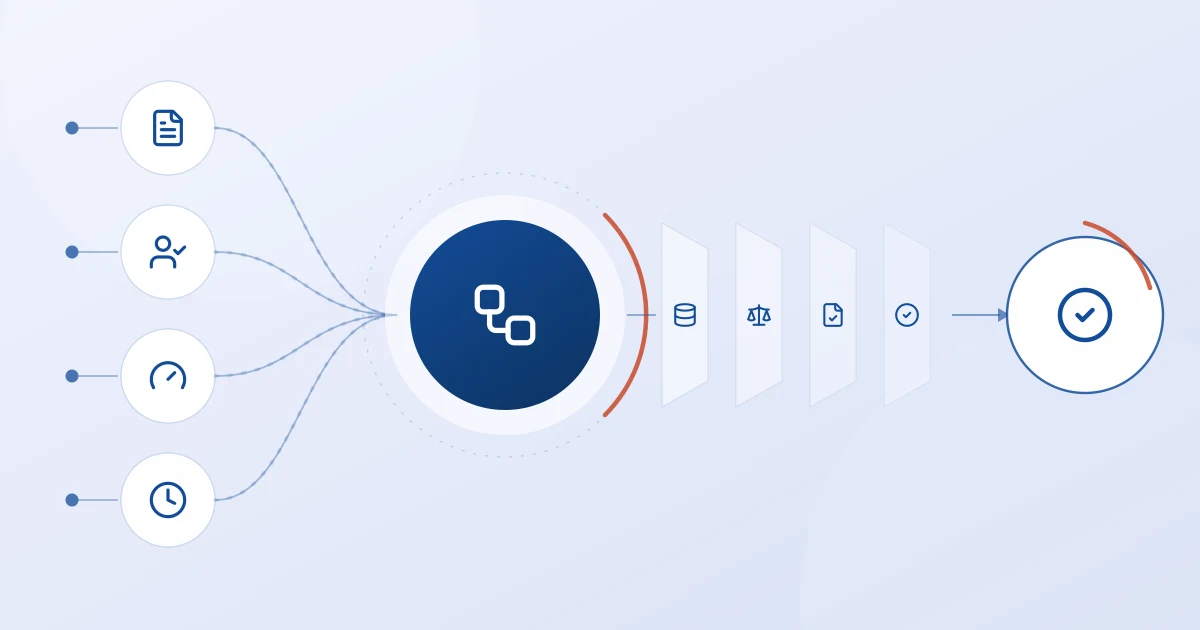
Where Loan Approval Time Actually Goes
In competitive lending, the speed of your approval process can decide whether a borrower closes with you or with someone faster. But "speed up approvals" is often aimed at the wrong target. The credit decision itself is rarely the bottleneck — the delays live in the spaces around it: application data re-keyed from one system into another, credit reports ordered by hand, documents chased over email, and information scattered across tools that don't talk to each other. Every handoff is a place where a file sits and waits.
Improving the process, then, is less about deciding faster and more about removing the gaps between steps. The lenders who shorten their cycle time meaningfully tend to attack three of those gaps in particular.
Three Gaps Worth Closing
Manual credit data collection. Ordering credit reports by hand and re-typing the results is slow and error-prone, and the errors are expensive — a transposed digit can route a file to the wrong decision. Pulling credit data automatically into the system where the application already lives turns an hours-long step into a near-instant one and removes the re-keying entirely. The data arrives consistently formatted and ready to act on.
Inconsistent preliminary decisions. When every application waits for manual review — even the ones that clearly qualify or clearly don't under your criteria — your underwriters spend their time on cases that don't need judgment. LASER's automated underwriting applies your lending criteria the same way every time, clearing the obvious cases instantly and routing only the genuine judgment calls to a person. The criteria remain yours; what changes is that they're applied consistently and without a queue. (This is rules-based automated credit decisioning, not a black-box score — you can see exactly why each decision was reached.)
Document friction. Paper and email-based document collection adds days and creates gaps in the file. Electronic upload, automated verification, and real-time status visibility for the borrower cut the back-and-forth and keep applicants from going cold while they wait.
Why the System of Record Matters
Most of these gaps share a root cause: the work is spread across systems that don't share data. Application details sit in one place, credit data in another, borrower communication in a third, and someone spends time reconciling them — or worse, re-entering the same information three times.
Running the process inside a single platform removes that overhead. When the CRM, the credit pull, the decisioning logic, and borrower communication all operate on the same record, there's nothing to reconcile and nothing to re-key. A loan officer sees the full picture of an applicant in one view, the workflow moves the file forward automatically, and every action is logged in one place — which is exactly what you want when an examiner or an auditor later asks how a decision was made.
This is where a Salesforce-native approach earns its keep. Rather than bolting a credit integration onto the side of your CRM, the data and the decisioning live natively inside it.
How LASER Credit Access Fits
LASER Credit Access® is the Salesforce-native layer that closes the first of those gaps directly: credit data from Experian, Equifax, and TransUnion — plus bank and income verification through Plaid — pulled straight into the Salesforce records your team already works in, with no re-keying and no separate system to manage. Because LASER ships with pre-built, pre-configured objects, the integration is in place without a custom build, and the full request-and-result history is captured in Salesforce as part of the normal workflow. For the bigger picture on how lenders are scaling this across verticals, see our outlook on loan management software on Salesforce.
The effect on the approval process is cumulative: the credit step stops being a manual detour, the decisioning has clean data to act on immediately, and the documentation trail builds itself. The borrower experiences a faster, smoother application; your team spends less time on data entry and reconciliation and more on the loans that need real attention.
Making the Change Stick
Technology alone doesn't shorten a cycle time — the rollout matters as much as the tools. A few principles separate the implementations that take from the ones that stall:
Start by mapping your current process honestly — every step from application to funding, with the time each one actually takes. You can't compress a bottleneck you haven't measured. Set a small number of concrete targets (time from application to decision, completion rate, cost per loan originated) so you can tell whether a change worked. Bring your team along rather than springing new tools on them; the most common reason a good system underdelivers is that the people using it weren't given the time and training to trust it. And treat it as ongoing — review the metrics, gather borrower feedback, and refine, rather than declaring victory at go-live.
The Bottom Line
A faster loan approval process is mostly a matter of removing the waiting between steps: automating the credit pull, letting consistent rules clear the easy decisions, and keeping the whole workflow on one auditable system of record so nothing gets re-keyed or lost. Done well, the result isn't just speed — it's a process that's faster, more consistent, and easier to stand behind when someone asks how a decision was made.
Related reading: When applicants can't or won't provide a Social Security Number, see our guide on accessing credit data without an SSN.