

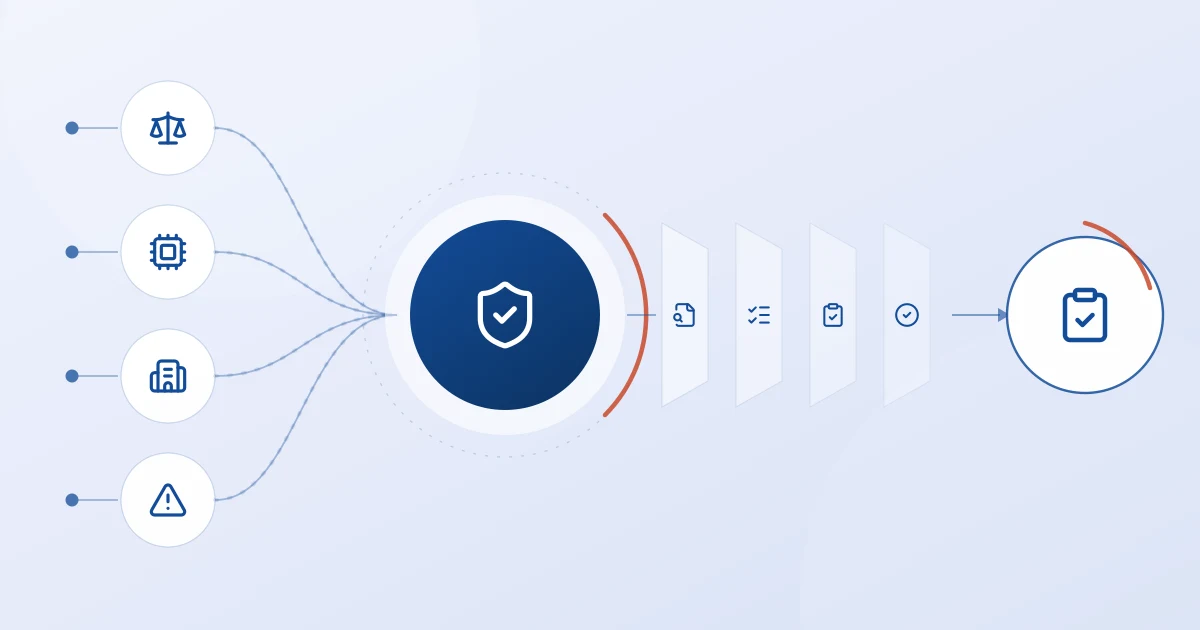
The biggest lending compliance challenges in 2026 are intensified CFPB and FTC enforcement, AI model risk and fair-lending scrutiny, diverging state privacy laws, third-party vendor oversight, and cybersecurity and data-governance requirements. What's new isn't the rules themselves — it's that regulators are enforcing all five at once, with far higher documentation expectations.
The Compliance Pressure Lenders Are Facing Right Now
The regulatory environment for lenders has shifted. Q2 2026 is not a period of guidance and rulemaking — it is a period of enforcement. The Consumer Financial Protection Bureau, the Federal Trade Commission, and an expanding network of state regulators are moving from issuing expectations to pursuing actions, and the institutions they are examining most closely are the ones whose documentation, model governance, and vendor oversight programs have not kept pace with the obligations already on the books.
For compliance officers and lending executives, the challenge is not learning a new set of rules. Most of the regulatory priorities driving Q2 2026 enforcement — UDAAP, fair lending, data security, AI model risk, third-party oversight — are not new frameworks. They are existing frameworks being enforced with greater precision, deeper audit trail requirements, and higher expectations for board-level accountability.
What is new is the convergence. Lenders are not managing one compliance priority right now — they are managing five simultaneously, while state-level privacy laws diverge and automated decisioning systems draw fresh scrutiny from multiple agencies at once. Understanding where your institution is most exposed, and closing the most consequential gaps first, is the definition of a defensible compliance posture in 2026.
Lenders operating on Salesforce have a structural advantage here: compliance workflows, credit access, and decisioning can run in a unified environment, which means the audit trails, documentation, and process consistency that examiners are demanding are built into the platform — not assembled manually after the fact.
So what does this mean for your institution? The lenders who enter Q2 2026 examinations with documented controls, model governance records, and clean vendor oversight programs will move through examination faster and with fewer findings. Those who don't will spend the quarter remediating.
The Five Compliance Challenges Defining Q2 2026
Regulators do not operate in isolation, and neither do the risks they are focused on. The five lending compliance challenges driving Q2 2026 enforcement activity are interconnected — weakness in one area tends to surface exposure in others. Understanding how they interact is as important as addressing each individually.
Challenge 1: Intensified Federal Enforcement Across Multiple Agencies
The CFPB's enforcement priorities for Q2 2026 are specific and well-documented. Examiners are focusing on UDAAP violations — Unfair, Deceptive, or Abusive Acts or Practices under 12 U.S.C. § 5531 — with particular attention to junk fee practices, servicing compliance failures, fair lending and redlining investigations, and the transparency of AI-driven credit decisions. The breadth of UDAAP authority means that almost any consumer-facing lending practice is potentially within scope, and the documentation standard for demonstrating compliance has risen substantially.
The FTC remains active on data security enforcement, consumer privacy practices, marketing and lead-generation compliance, and cybersecurity failures — with the FTC Safeguards Rule at 16 CFR Part 314 continuing to set the baseline for what a defensible information security program must include. For publicly traded institutions, SEC scrutiny of cybersecurity governance disclosures and internal control transparency adds a third federal enforcement dimension.
The through-line across all three agencies is documentation. Examiners are requesting deeper audit trails, clearer evidence of board-level oversight, and explicit records showing that identified compliance risks were escalated and addressed — not just flagged.
Challenge 2: AI Model Risk and Fair Lending Scrutiny
Automated underwriting and AI-driven decisioning models are now a primary examination target. Regulators are evaluating not just whether a model produces accurate outputs, but whether the institution understands why — and can demonstrate that understanding to an examiner. The specific areas under review include disparate impact analysis, algorithmic bias testing, training data governance, and the accuracy of adverse action notices generated by automated systems.
The adverse action notice issue deserves particular attention. Regulation B requires that credit denials include specific reasons that are accurate, meaningful, and intelligible to the applicant. When a machine learning model generates a credit decision, the institution must be able to translate that model's output into a notice that satisfies Regulation B — which requires a documented explainability framework, not just a technically accurate model. Institutions that cannot produce clear explainability records for their automated decisioning systems are carrying fair lending exposure that examiners will find.
Challenge 3: State Privacy Law Divergence
The compliance complexity created by state-level privacy law divergence has reached a threshold where a single national compliance policy is no longer a defensible posture for multi-state lenders. California enforcement under the California Privacy Rights Act (Cal. Civ. Code § 1798.100 et seq.) is intensifying, with regulators examining opt-out mechanisms, data retention practices, and the treatment of sensitive personal information. Virginia has introduced amendments affecting opt-out rights and consumer data access provisions. Additional developments in Colorado and Connecticut are adding further jurisdiction-specific obligations.
For multi-state lenders, this means materially different disclosure obligations, consumer opt-out mechanisms, and data retention standards depending on where a borrower is located — and the compliance documentation burden to match. For a detailed analysis of how credit data and PII obligations layer across regulatory frameworks, see our overview of why credit data and PII are regulated.
Challenge 4: Third-Party and Vendor Risk Management
Regulators are holding lenders directly accountable for the compliance failures of their vendors — including lead generators, loan origination software providers, data aggregators, call centers, and marketing affiliates. The examination expectation is no longer that lenders conduct initial due diligence on third parties; it is that lenders maintain ongoing monitoring, documented contractual compliance controls, and clear audit rights across all material vendor relationships.
Board and senior leadership oversight of outsourced functions is an explicit examination criterion. Institutions that treat vendor risk as a procurement function rather than a governance function are carrying examination exposure that is preventable.
Challenge 5: Cybersecurity and Data Governance
Data breaches, ransomware events, and consumer data misuse are driving enforcement activity across the CFPB, FTC, and state regulators simultaneously. The compliance expectations are specific: incident response planning, data minimization practices, encryption and access controls, timely consumer breach notifications, and documented board-level reporting structures. Cybersecurity has crossed from IT governance into regulatory compliance, and examiners are evaluating it accordingly.
| Challenge | Primary Regulatory Authority | Documentation Exam Focus |
| UDAAP / Junk Fees / Servicing | CFPB (12 U.S.C. § 5531) | Consumer communication records, fee disclosure audit trails |
| AI Model Risk / Fair Lending | CFPB, OCC, Fed | Bias testing logs, explainability frameworks, adverse action accuracy |
| State Privacy Compliance | CA CPRA, VA CDPA, CO CPA | Jurisdiction-specific opt-out records, data retention documentation |
| Third-Party Vendor Risk | CFPB, OCC, FTC | Ongoing monitoring records, contract compliance controls |
| Cybersecurity / Data Governance | FTC (16 CFR § 314), State AGs | Incident response plans, breach notification records, board reporting |
So what does this mean for your institution? The five challenges above share a common examination criterion: documentation. Institutions that can produce organized, timestamped, examination-ready records across all five areas will move through Q2 2026 scrutiny with significantly less remediation exposure than those relying on informal processes.
How These Challenges Connect to Lender Business Outcomes
Compliance failures in 2026 are not just regulatory events — they are business events. CFPB enforcement actions generate public consent orders, civil money penalties, and remediation requirements that can run into millions of dollars and consume compliance and legal resources for years. Fair lending findings carry reputational exposure that affects institutional relationships, partner confidence, and borrower acquisition. State privacy enforcement actions are increasingly public and specific.
Beyond enforcement, the indirect costs are substantial. Institutions that lack documentation and model governance programs spend examination periods in reactive mode — producing records under examiner request rather than presenting organized compliance files. That reactive posture extends examination timelines, increases the probability of findings, and diverts senior leadership attention from growth and operations.
The institutions that fare best in Q2 2026 examinations will be those that treat compliance infrastructure as a business asset rather than a cost center. Automated compliance workflows that produce audit trails without manual effort, decisioning systems that generate examination-ready documentation as a byproduct of normal operations, and vendor oversight programs with continuous monitoring rather than annual reviews — these are the capabilities that compress examination timelines and reduce finding rates.
For Salesforce-native lenders, these capabilities are achievable without building parallel systems. LASER Credit Access® unifies credit access, built-in compliance, and decisioning in a single Salesforce environment — which means the documentation that examiners require is generated through the same workflow that originates loans. For a broader view of how interconnected compliance challenges are transforming lending operations, the pattern is consistent: integrated compliance infrastructure outperforms siloed compliance programs in both examination outcomes and operational efficiency.
So what does this mean for your institution? The cost of compliance infrastructure that works is a fraction of the cost of one enforcement action. The institutions building now are buying insurance against Q2 2026 and positioning for the examinations that follow.
Ready to see how LASER handles lending compliance challenges natively inside Salesforce?
What the Regulatory Record Shows
The enforcement trajectory heading into Q2 2026 is well-documented. The CFPB has issued supervisory guidance making clear that UDAAP enforcement will focus on practices that harm consumers even when those practices do not violate a specific rule — meaning the absence of a rule violation is not a compliance defense. Fair lending enforcement has expanded beyond traditional redlining patterns to include algorithmic pricing and automated underwriting systems, with regulators citing disparate impact liability under the Equal Credit Opportunity Act (15 U.S.C. § 1691) even in the absence of discriminatory intent.
The FTC's enforcement record under the Safeguards Rule (16 CFR Part 314) continues to generate consent orders that specify exactly what a deficient information security program looks like — giving lenders a detailed negative map of the documentation gaps that produce findings. State enforcement actions under the CPRA in California have accelerated, with the California Privacy Protection Agency pursuing enforcement independent of private litigation, creating a dual enforcement pathway that raises the probability of consequence for non-compliant institutions.
On AI model risk, the OCC's model risk management guidance (OCC Bulletin 2011-12, updated with subsequent interagency guidance) establishes a framework that examiners are now applying directly to machine learning models — requiring independent model validation, documented assumptions, and ongoing performance monitoring. Institutions that deployed AI underwriting tools without updating their model risk management frameworks to address these requirements are carrying examination exposure that is both predictable and addressable.
In our work with commercial lenders, the compliance gaps that generate the most examination friction are not the novel ones — they are the documented ones that were identified and not remediated. Examiners do not expect perfection; they expect evidence that identified risks are managed. For context on how FinCEN's AML/CFT modernization requirements are adding another documentation layer to the compliance stack, that framework illustrates the same pattern: regulatory expectations are specific, enforcement is active, and documentation is the variable that determines examination outcomes.
So what does this mean for your institution? The regulatory record for Q2 2026 is not ambiguous. The enforcement priorities are published, the documentation expectations are specific, and the institutions that are examined will be measured against a standard they have had time to prepare for.
What Lenders Should Do Before Q2 2026 Examinations Begin
Five actions, in priority order, for compliance teams working against a Q2 2026 examination timeline.
So what does this mean for your institution? These five steps are not aspirational — they are the specific actions that separate institutions with defensible compliance postures from those that enter Q2 2026 examinations without adequate preparation. Each step is achievable before the examination window.
Why LASER for Lending Compliance in 2026
The compliance demands of Q2 2026 require infrastructure that produces documentation automatically, enforces process consistency across every loan, and connects compliance workflows directly to credit decisioning — without manual intervention and without separate systems.
LASER Credit Access delivers exactly that. Salesforce-native credit access, built-in compliance, and decisioning — unified in a single app, ready from day one. Every credit pull, identity verification, adverse action, and compliance workflow runs inside Salesforce, which means every interaction generates the audit trail that examiners require as a natural byproduct of normal operations. There is no post-hoc documentation assembly, no gap between the decisioning system and the compliance record, and no separate login for compliance staff to access the records they need.
LASER's automated compliance workflows enforce process consistency across every loan — so the consistency of process that regulators are looking for is not a manual discipline, it is a structural feature. Identical loans are processed identically, and the records that demonstrate that consistency are available immediately.
To learn more about LASER Accuracy, LLC and our background in building compliant credit infrastructure for lenders, visit our About page. For additional context, see our resources on why credit data and PII are regulated and FinCEN's AML/CFT modernization requirements.
Ready to Build a Compliance Posture That Holds Up in 2026?
The lending compliance challenges of Q2 2026 are specific, documented, and already driving examination activity. The lenders who prepare now — with organized documentation, model governance records, vendor oversight programs, and integrated compliance infrastructure — will navigate this period with far less remediation exposure than those who don't.
The most productive next step is a direct conversation about where your compliance posture has gaps and how Salesforce-native compliance tools can close them before an examiner asks.
Source article: https://www.winnow.law/news/regulatory-compliance-in-the-lending-industry-top-q2-2026-challenges-for-banks-credit-unions-lenders
Federal citations: 12 U.S.C. § 5531 · 16 CFR Part 314 · Cal. Civ. Code § 1798.100 et seq. · OCC Bulletin 2011-12 · 15 U.S.C. § 1691