

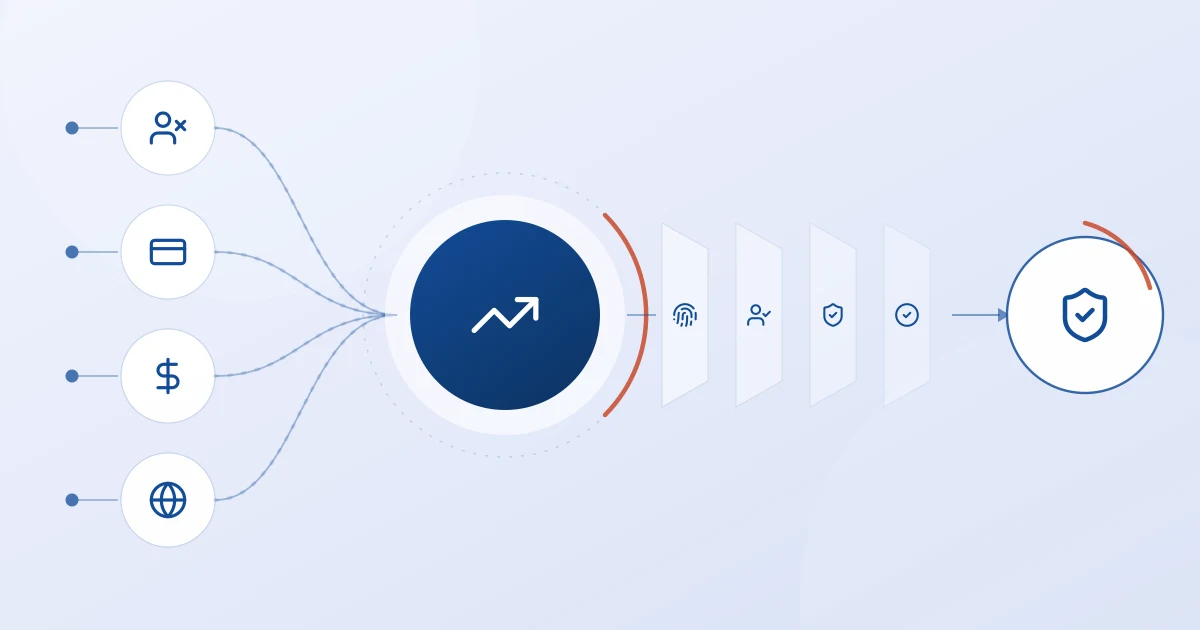
The Scale of the Problem Is No Longer Theoretical
For a lender, $47 billion is not an abstract industry statistic — it is the measured output of the fraud machinery now aimed squarely at loan origination and account servicing.
Identity fraud losses across North America have reached $47 billion — a figure that encompasses account takeover fraud, new-account fraud, and identity fraud scams that increasingly target financial institutions and their borrowers. For lenders, the data represents more than a headline. It is a direct measure of the fraud infrastructure that now systematically targets the credit application and account management processes.
According to Javelin Strategy & Research's 2024 Identity Fraud Study, account takeover fraud alone generated $15.6 billion in losses — up from $12.7 billion the prior year. New-account fraud reached $6.2 billion, compared with $5.3 billion the year before. Both categories are accelerating, driven by the same underlying dynamic: fraudsters now have access to AI-powered tools, stolen credential databases, and synthetic identity packages that make traditional verification controls inadequate.
For lenders using Salesforce, the response is not to add more manual review steps — it is to automate the right controls at the right points in the workflow. Schedule a Discovery Call to see how LASER's ACCESS and COMPLY pillars address both fraud vectors directly.
Account Takeover Fraud: The $15.6 Billion Problem
Account takeover fraud occurs when a criminal gains unauthorized access to a legitimate account — and in the lending context, this means accessing loan accounts, lines of credit, and the customer data those accounts contain. The attack vectors are varied:
| Attack Vector | How It Works | Why It Targets Lenders |
| Credential Stuffing | Testing stolen username/password combinations against account portals | Lenders hold high-value account data and disbursement capabilities |
| Phishing / Smishing | Social engineering borrowers into providing credentials | SMS-based attacks reached 54% of initial fraud contacts in 2024 |
| SIM Swapping | Hijacking phone numbers used for SMS-based MFA | Bypasses common two-factor authentication |
| Synthetic Voice / Deepfake | AI-generated audio impersonating borrowers or staff | Increasingly used in customer service and wire authorization contexts |
The $15.6 billion in account takeover losses represents actual financial damage — funds transferred, accounts drained, credit drawn. For lenders, account takeover exposure extends beyond direct losses to include regulatory obligations: GLBA Safeguards Rule incident response requirements, FTC notification obligations if 500 or more customers are affected, and potential FCRA compliance exposure if account data is misused.
New-Account Fraud: The Synthetic Identity Connection
New-account fraud is where identity fraud and credit risk intersect most directly for lenders. At $6.2 billion and growing, it represents the financial consequence of identity verification failures at onboarding — and a significant portion of that figure is driven by synthetic identity fraud that never appears in fraud statistics because it is misclassified as credit loss.
Synthetic identities — fabricated by combining a real Social Security number with invented names, addresses, and dates of birth — are engineered to pass standard KYC verification at onboarding. They build legitimate-looking credit histories over months or years before executing bust-out schemes. TransUnion estimates over $3 billion in lender exposure attributable to suspected synthetic identities, most of it booked as ordinary charge-offs. These losses keep climbing as schemes mutate and migrate across institution types — see fraud scheme mutations driving synthetic identity and check fraud losses to record levels.
As detailed in our analysis of how synthetic identity fraud works, the attack pattern specifically targets the compliance gap between BSA/AML CIP requirements and FCRA permissible purpose — the point in the lending workflow where identity is being established but verification may not yet be complete.
What the $47 Billion Figure Means for Lender Risk Programs
The aggregate loss figure obscures the distribution of fraud across institution types. Retail online-only banks face the highest identity verification failure rates — with some verification platforms reporting failure rates above 5% at digital-only institutions. Traditional lenders and credit unions see lower rates, but face the same exposure when they expand digital onboarding without corresponding verification controls.
The data points to three specific risk program implications:
Verification must be automated, not manual. Manual document review cannot scale to the volume of digital applications, and manual reviewers are increasingly unable to detect AI-generated fraudulent documents. Automated, sequenced identity verification that cross-references identity elements against authoritative data sources is the necessary foundation.
Sequencing matters as much as verification. Completing CIP verification before pulling credit reports — rather than in parallel or afterward — closes the timing gap that synthetic identities exploit. As detailed in our KYC timing and FCRA compliance analysis, this sequencing satisfies both BSA/AML and FCRA requirements simultaneously.
The audit trail is itself a control. Institutions that maintain complete, automated records of every identity verification step, every credit pull, and every compliance checkpoint generate the documentation that demonstrates a sound program to examiners — and creates the evidentiary record needed when fraud losses are disputed.
Building Fraud-Resistant Lending Infrastructure
The $47 billion loss figure is not primarily a technology failure — it is an infrastructure failure. Institutions that manage identity verification, credit data access, and compliance documentation as separate manual processes have inherent gaps at the intersections. Fraudsters have identified those gaps and built attack strategies around them.
The institutions that are most effectively managing identity fraud exposure are those that have embedded automated verification, sequenced compliance controls, and real-time identity data into a unified lending workflow. When these controls operate as a system rather than as separate steps, the gaps that fraud exploits are structurally closed — not dependent on staff vigilance or periodic policy reviews.
What This Means for Your Institution
Identity fraud at $47 billion is not a background risk for lenders — it is an active operating environment. The question for lending institutions is not whether to invest in fraud prevention, but whether their current controls are structured to address the specific attack patterns that are driving losses.
Account takeover and new-account fraud are both addressable through the same foundation: automated identity verification integrated into the lending workflow, sequenced before credit access, and documented with the audit trail that compliance requires. Institutions that build this foundation into their technology platform — rather than their policy binders — are operating with structurally different fraud exposure than those that have not.
Schedule a Discovery Call to see how LASER's ACCESS and COMPLY pillars integrate automated identity verification and CIP compliance directly into your Salesforce lending workflow.