

A soft credit pull is a credit check that doesn't affect the borrower's score and isn't shown to other lenders. Only hard inquiries — the ones tied to a credit application the borrower authorized — are disclosed to third parties, which is why prequalification leaves no trace a competing lender can see. The borrower sees every soft pull on their own file; you don't.
The Inquiry Your Borrower Sees and You Don't
Here is a question that trips up experienced lending teams: if you and your borrower are looking at "the same" credit file, why don't you see the same inquiries? A borrower who pulls their own report sees a full list of everyone who has reviewed their credit recently — including the soft pull credit report you ran during prequalification. Pull that same borrower yourself, and those soft inquiries are gone. You see hard inquiries and almost nothing else in that section.
This is not a glitch, a bureau setting, or a difference between Experian, Equifax, and TransUnion. It is a deliberate design choice baked into federal law, and it shapes how you should read — and how much you should trust — the inquiry section of any report you pull. Lenders working inside a Salesforce-native credit workflow can capture this distinction cleanly in the record, rather than guessing later about what a borrower could or couldn't see.
Understanding the asymmetry matters because the inquiry section is one of the first places underwriters look for signs of credit-seeking behavior. So what? If you assume the inquiries you see represent everything that happened to that borrower's file, you will misread their recent activity — and base decisions on an incomplete picture.
Soft Pull vs Hard Pull: Two Inquiries, Two Audiences
Every credit check leaves a record, but not every record is shared the same way. The cleanest way to hold this straight is to separate what the inquiry does to the score from who is allowed to see it — because those are two different rules.
A hard inquiry happens when a borrower applies for credit and authorizes a lender to evaluate that application. It can affect the score, and it is visible to anyone who later pulls the report. A soft inquiry — a soft credit inquiry — happens when credit is reviewed for a purpose other than a borrower-initiated application: prequalification, account review, prescreened offers, or the borrower checking their own file. It does not affect the score, and it appears only on the version of the report the borrower pulls themselves.
| Soft Pull | Hard Pull | |
| Triggered by | Prequalification, account review, prescreen, self-check | Borrower-authorized credit application |
| Affects credit score? | No | Yes (typically a few points) |
| Borrower sees it on their own report? | Yes | Yes |
| A later lender sees it? | No | Yes |
| Stays on file | Up to ~24 months | Up to 24 months |
That fourth row is the entire point. Both inquiry types sit in the borrower's file for up to two years, but only the hard inquiry travels with the report when a third party requests it. So what? When you run a soft pull credit report for prequalification, you are not leaving a visible footprint that a competing lender will later see — and the soft pulls you see on a borrower are, by definition, the rare ones the bureau is permitted to surface to you.
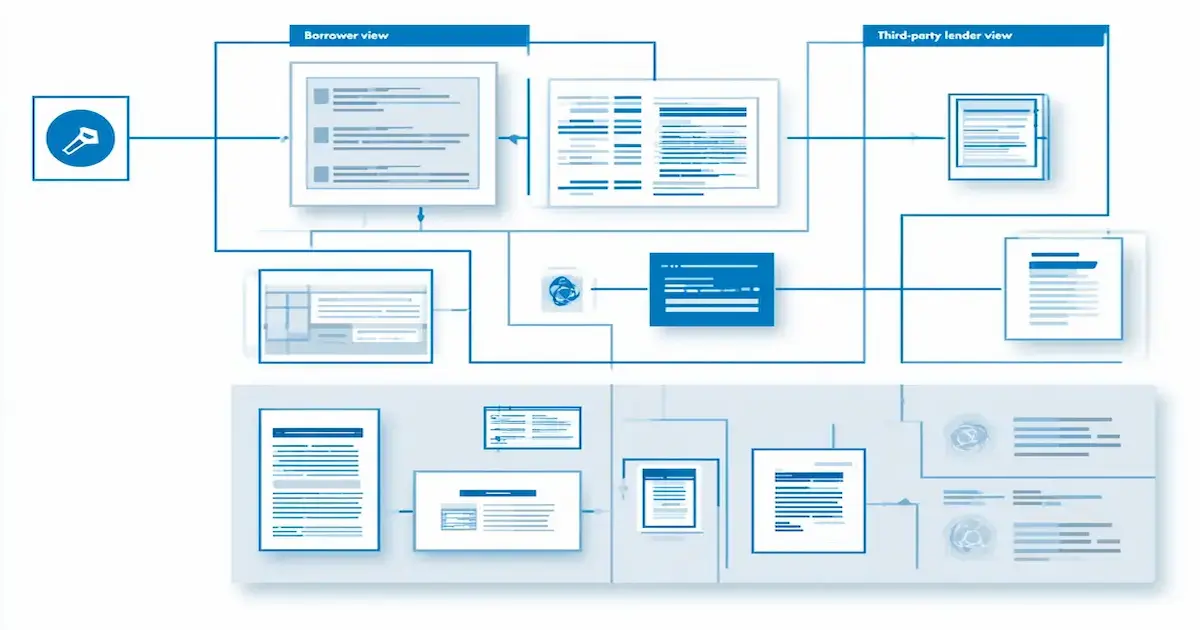
How soft and hard inquiries route to the borrower view versus the third-party lender view.
Why This Helps Lenders, Not Just Borrowers
The visibility rule is often framed as a consumer protection — and it is — but it works in a lender's favor more than most teams realize.
Because a soft pull credit report is invisible to other lenders, you can evaluate a borrower's creditworthiness before a formal application without signaling your interest to competitors or nudging the borrower's score downward. Prequalification becomes a low-friction first step rather than a commitment. Borrowers are more willing to start the conversation when they know a preliminary look won't cost them points, and you get a real read on the file before anyone fills out an application.
It also sharpens how you interpret the reports you do pull. When you see a cluster of hard inquiries on an incoming applicant, you are looking at genuine recent credit-seeking activity — not prequalification noise — because the soft pulls have already been filtered out by the bureau before the report reached you. That makes the inquiry section more meaningful, not less. For a fuller picture of why credit reports and PII are regulated the way they are, the inquiry rules are a useful place to start.
So what? The asymmetry lets you assess more borrowers earlier, with cleaner signal and without penalizing the people you're trying to serve — which is exactly the kind of efficiency that compounds across a pipeline.
Ready to see how LASER handles credit pulls — soft and hard — natively inside Salesforce?

A prequalification funnel using soft pull screening before a formal application.
The Proof: It's Written Into the FCRA
This is not industry custom or a bureau courtesy. The rule lives in the Fair Credit Reporting Act, and it has two halves that fit together.
First, the restriction on lenders. Under 15 U.S.C. § 1681b, except as provided in § 1681g(a)(5), a consumer reporting agency shall not furnish to any person a record of inquiries made in connection with a credit or insurance transaction that the consumer did not initiate. Prescreened offers and account-review pulls are exactly those non-consumer-initiated inquiries — so the bureau is barred from including them in the report it sells to a third party.
Second, the disclosure to the borrower. 15 U.S.C. § 1681g(a)(5) requires the bureau, when a consumer requests their own file, to include a record of all inquiries from the preceding one-year period that identified the consumer in connection with a credit or insurance transaction not initiated by the consumer. Same inquiries, opposite outcome: hidden from third parties, disclosed to the borrower.
The regulators describe it in plain language. The Consumer Financial Protection Bureau states that soft inquiries are shown only to the consumer reviewing their own report and are not visible when others purchase the report. The U.S. Small Business Administration says only hard inquiries can be seen by others — they do not see the soft inquiries, only the consumer does. And a federal appeals court, addressing the issue directly in 2022, observed that soft inquiries by definition cannot be viewed by third parties.
One honest caveat worth keeping on file: the blackout is not absolute across every context. Within a single industry, certain account-review soft inquiries can be visible to peer users — an insurer, for example, may see other insurance-related soft inquiries. For ordinary lending, where you are pulling a borrower's consumer report, the non-consumer-initiated soft pulls do not appear. So what? When an examiner or a borrower asks why your file shows different inquiries than the borrower's own copy, you can point to the statute rather than to a vendor — and that is the difference between a defensible answer and a guess.

The FCRA sections that govern soft pull credit inquiry disclosure for lenders.
What Lenders Should Do With This
Knowing the rule is one thing; building it into how your team works is another. A few practical steps:
So what? Teams that operationalize the soft/hard distinction make faster early decisions, run cleaner audit trails, and avoid misreading the very section of the report underwriters lean on most.
Why LASER for Credit Pulls Inside Salesforce
The mechanics above are only as useful as your ability to act on them inside the system where your lending actually happens. Running prequalification soft pulls and application-stage hard pulls in disconnected tools means the record of what you pulled and why lives somewhere other than the deal — which is precisely where a compliance question will eventually look.
LASER Credit Access pulls credit from the major bureaus and credit reporting agencies directly into Salesforce, so the inquiry — its type, its timing, and the decision it supported — is captured against the borrower record automatically. Salesforce-native credit access, built-in compliance, and decisioning — unified in a single app, ready from day one. That means your team reads inquiry sections, prequalifies borrowers, and documents the basis for each pull without leaving the CRM. Where that inquiry record sits alongside fraud signals and compliance documentation is covered in credit bureau integration on Salesforce for credit, fraud, and compliance risk.
To see how Salesforce-native credit access fits your prequalification and underwriting workflow, the fastest path is a conversation.

Toward a compliance discussion on soft pull credit report visibility in Salesforce.
Ready to Read Every Inquiry With Confidence?
The single takeaway: a soft pull credit report is visible to your borrower but not to other lenders, and that asymmetry is written directly into the FCRA — which means the inquiry section you pull is a curated view, not the whole story.
Build that understanding into where your team already works, and prequalification, underwriting, and documentation stop being separate steps.